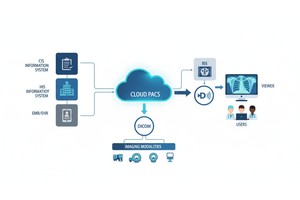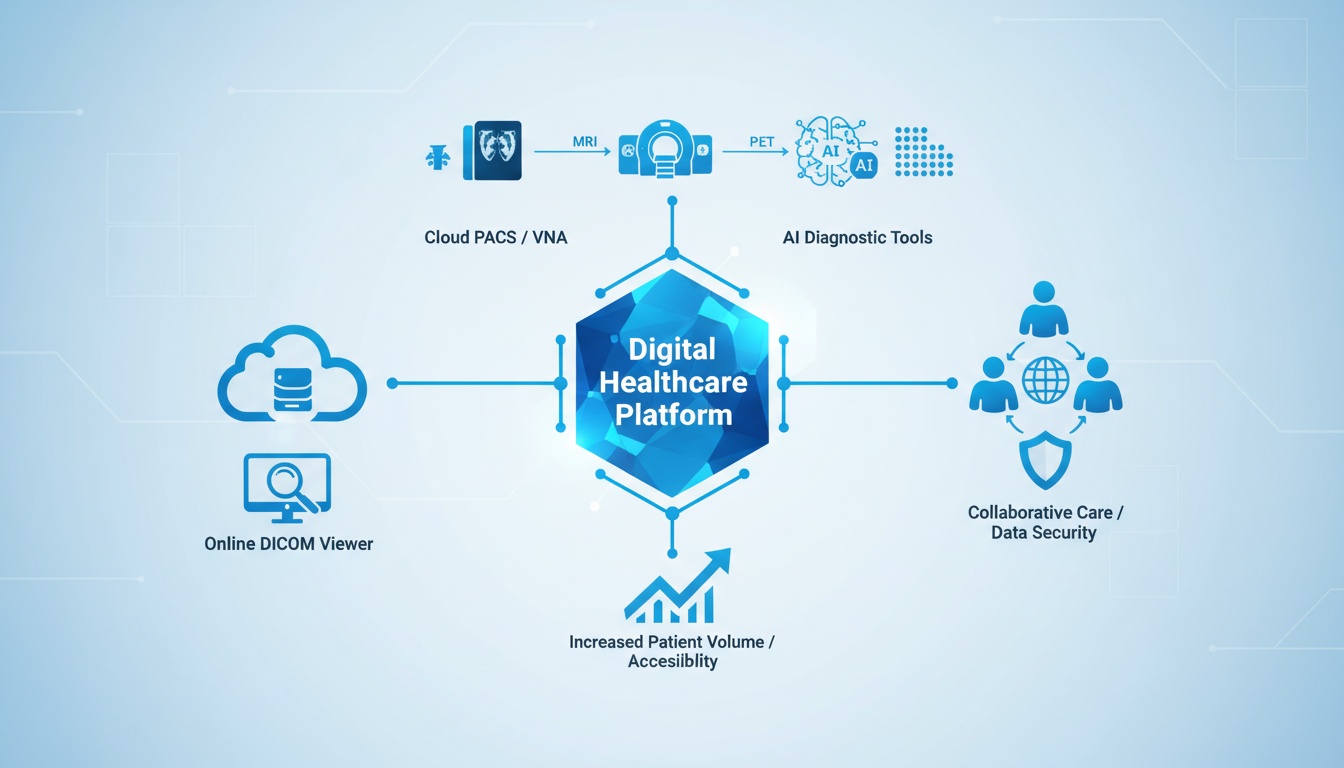
Medical imaging software denotes the digital platforms utilized to archive, access, display, share, and handle diagnostic images like CT, MRI, ultrasound, X-ray, and PET scans. In the current healthcare landscape, this generally encompasses Cloud PACS (Picture Archiving and Communication Systems), online DICOM viewers, vendor-agnostic archives (VNA), and more frequently, AI-supported diagnostic tools.
These platforms are the base of radiology practices. They help doctors make decisions about patient care. They also make it easy for doctors in locations to work together safely.. They make sure that imaging data is always available and follows the rules as more patients come in.
For people in charge of healthcare, the big question is no longer about going digital with imaging. The big question for healthcare executives now is whether to build their system or use a cloud-based SaaS solution.
Throughout North America, Europe, Asia-Pacific, and various English-speaking healthcare markets, imaging providers are reassessing their infrastructure strategies.
Conventional on-site PACS setups necessitate:
• Committed Physical Servers
• Cycles For Updating Hardware
• Local It Support
• Intricate Systems For Backup And Disaster Recovery
Although these systems have aided radiology for many years, they bring about capital expenses, limitations in scalability, and operational risks.
Cloud-based imaging platforms transform imaging infrastructure from a reliance on hardware to a service-oriented model. This enables healthcare organizations to:
• Launch More Quickly
• Adjust Dynamically
• Minimize Ongoing It Expenses
• Facilitate Safe Remote Entry
• Facilitate Collaboration Across Multiple Sites
For imaging centers operating in competitive, resource-limited settings, this change is typically both operationally and financially important.
Healthcare organizations sometimes think about creating tailored imaging solutions. Although this method seems to provide flexibility, it also adds complex problems.
| Consideration | Cloud-Based Imaging SaaS | Custom In-House Development |
| Deployment Timeline | Rapid implementation | Extended development cycle |
| Cost Structure | Predictable subscription model | Upfront capital + ongoing dev cost |
| Scalability | Elastic cloud architecture | Hardware-dependent scaling |
| Security & Compliance | Built-in regulatory framework | Must be engineered internally |
| System Maintenance | Vendor-managed updates | Internal IT responsibility |
| Standards Integration | Native DICOM, HL7, FHIR support | Custom integrations required |
• Imaging Networks Across Multiple Locations
• Telemedicine Imaging Services
• Expanding Outpatient Radiology Practices
• Entities Aiming For Consistent Operational Costs
• Sites With Restricted Internal Development Capabilities
• Extremely Focused Research Organizations
• Exclusive Imaging Processes
• Thorough Incorporation With Established Proprietary Systems.
For many healthcare providers, the ongoing costs, compliance challenges, and maintenance requirements of custom development exceed the benefits of perceived flexibility.
The primary difference between cloud imaging platforms and conventional systems is technical and also structural.
An imaging platform as a Service (SaaS) offers:
• Ongoing Updates For Features
• Management Of Security Patches
• Monitoring Of Infrastructure
• Inherent Redundancy
• Automated Scalability
• Uptime Commitments For Service Levels
Instead of handling servers and software versions in-house, healthcare organizations utilize imaging infrastructure as a managed service.
This model is really important in places where healthcare teams have to handle a lot of systems all at once. When you give the job of handling imaging infrastructure to a platform, it makes things easier to manage and still works very well.
 - Created by PostDICOM.jpg)
Contemporary imaging applications need to blend effortlessly into larger healthcare systems.
Fundamental standards consist of:
DICOM – Worldwide standard for storing and transmitting medical images.
HL7 – Framework for clinical messaging
FHIR – Contemporary API-based healthcare integration
IHE Profiles – Organized integration processes
Healthcare systems with inadequate interoperability frequently encounter:
• Information Silos
• Postponed Reporting
• Integration Constraints
• Workarounds Done Manually
Cloud-native platforms are usually created with these standards in mind from the start, minimizing integration challenges among hospitals, diagnostic networks, and referral systems.
Artificial intelligence is becoming more integrated into imaging processes, aiding radiologists with:
• Prioritization Of Cases
• Segmentation Of Images
• Support For Detection
• Numerical Assessment
• Improvement Of Structured Reporting
Cloud platforms are especially ideal for integrating AI because of their centralized data settings and scalable computing resources.
Crucially, AI acts as a decision-support framework — rather than a substitute for clinical knowledge. Regulatory approval, quality assurance, and radiologist supervision continue to be essential.
Healthcare data protection requirements vary across jurisdictions, but core principles remain consistent:
• Encryption In Transit And At Rest
• Role-based Access Control
• Detailed Audit Logging
• Data Residency Considerations
• Disaster Recovery Planning
Cloud imaging software as a service platforms help different areas follow rules while keeping things run smoothly.
Healthcare groups that work in places or help people in different areas can benefit from having one main system but also following local rules. This makes it easier for them to manage everything.
They need to make sure they follow the rules, in each place they work.This way they can keep things organized and make sure everything is done correctly.
For executives and administrators, decisions regarding imaging infrastructure impact beyond just technical performance.
Important factors to take into account are:
• Total Cost Of Ownership (tco)
• Capital Distribution Approach
• Cybersecurity Vulnerability
• Employee Workload
• Planning For Business Continuity
• Capacity To Accommodate Increasing Imaging Requirements
SaaS-based imaging changes infrastructure from expensive capital assets to reliable service costs. This can enhance budget consistency while facilitating modernization efforts.
Healthcare organizations assessing imaging platforms might take into account the subsequent organized method:
• Evaluate Existing Pacs Constraints And Integration Shortcomings.
• Establish Anticipated Growth Expectations.
• Assess Adherence To Governance And Data Compliance Standards.
• Compare Tco Over Five To Ten Years.
• Execute Preliminary Workflow Verification.
This assessment guarantees consistency among clinical, technical, and financial goals.
Modern cloud imaging services utilize high-level encryption, organized access controls, audit trails, and robust infrastructure. In numerous instances, security standards surpass what smaller organizations can uphold on their own.
Conventional PACS depends on physical hardware and local IT administration. Cloud PACS provides storage, viewing, and distribution via a web-based platform, minimizing hardware reliance and enhancing scalability.
Certainly. The majority of contemporary platforms accommodate DICOM, HL7, and FHIR standards, facilitating compatibility with RIS, HIS, and EHR systems.
Systems can offer personalized functionalities but bring prolonged development schedules, maintenance challenges, and continuous compliance obligations.
Medical imaging systems have changed a lot over time. They used to be setups in one place. Now they are connected around the world and work like a service.
Medical imaging frameworks can still be developed in house for needs.. Cloud based Medical imaging solutions are better for hospitals and other healthcare organizations. They can handle a lot of work are reliable follow the rules and are cost effective in the run.
With the rise of imaging volumes and the normalization of cross-site collaboration, opting for a service-oriented architecture is driven more by a sustainable strategy than by technological preference.
|
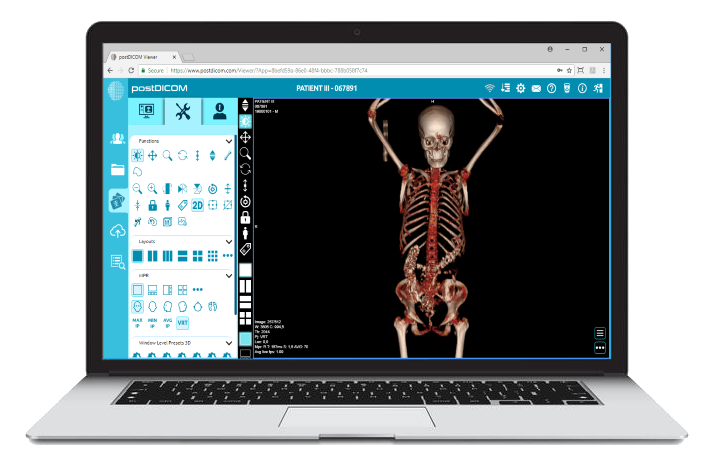
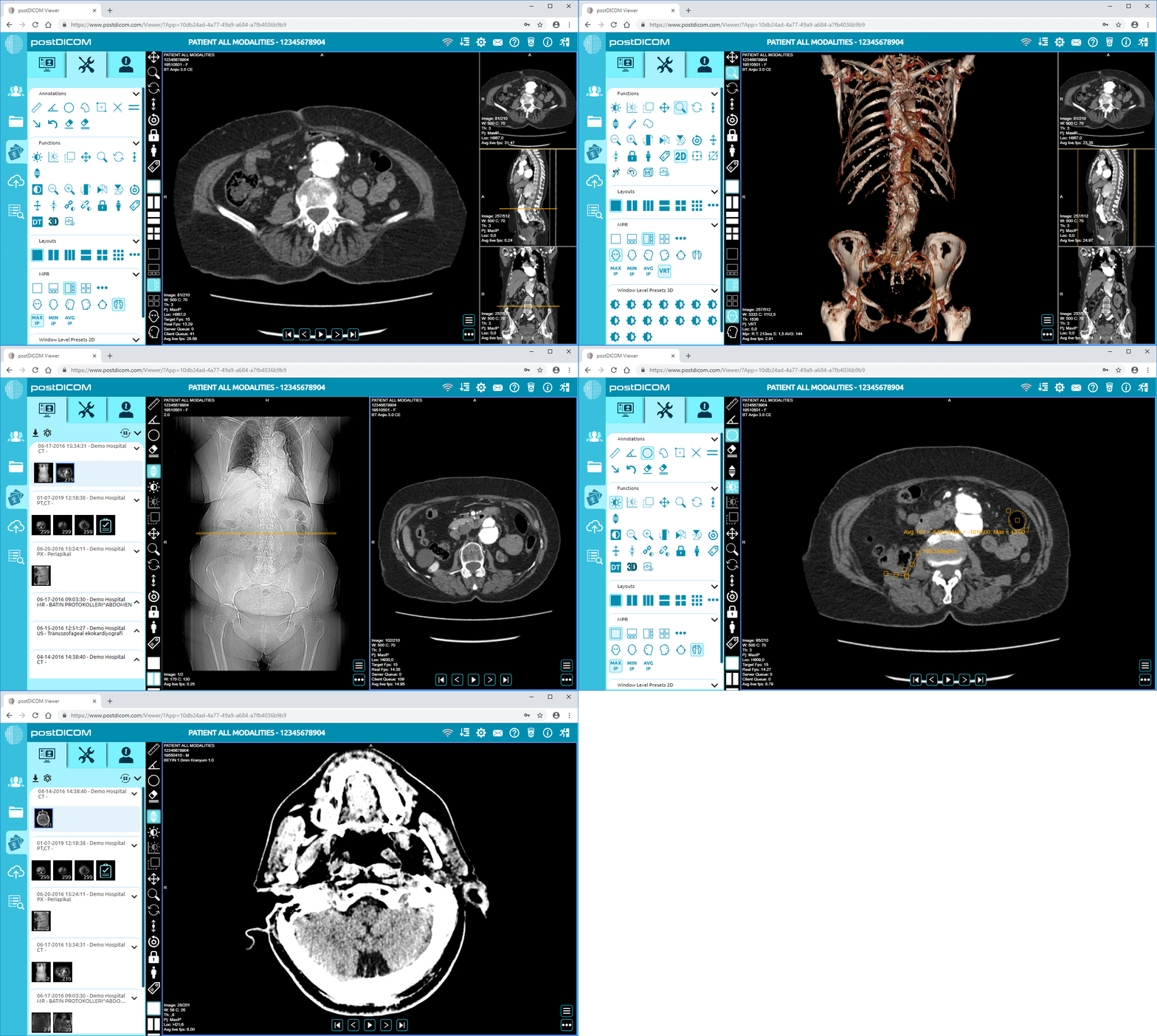
Cloud PACS and Online DICOM ViewerUpload DICOM images and clinical documents to PostDICOM servers. Store, view, collaborate, and share your medical imaging files. |